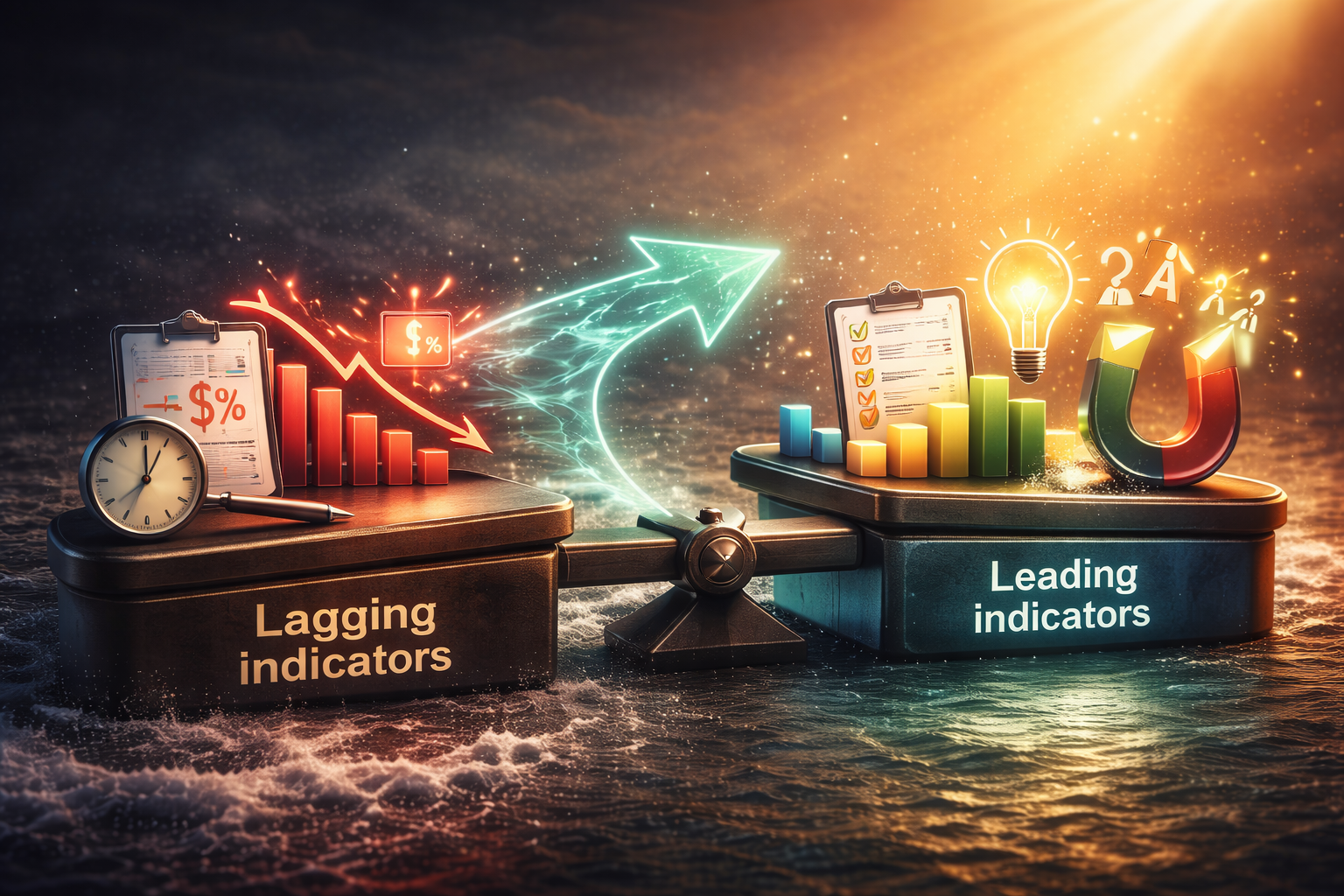
In the vast ocean of business, many entrepreneurs, coaches, and consultants find themselves reacting to the wake of their efforts rather than anticipating the tides ahead. This common pitfall – focusing solely on lagging indicators – is akin to a captain steering by looking only at the ship’s trail. By the time revenue drops or churn escalates, the real issue has already passed unnoticed, leaving you scrambling to correct a course that was set adrift long ago. A proactive approach is important, guiding businesses to harness the predictive power of leading indicators to steer your business toward sustained growth and profitability.
The Wake vs. The Current: Understanding the Difference
Imagine your business journey as a voyage across the open sea. To navigate effectively, you need to understand both where you’ve been and where you’re headed.
-
Lagging Indicators: The Wake of Your Ship These are the outcomes, the results of past activities. They tell you where you’ve been, how fast you were going, and what your past performance looked like. While essential for understanding historical performance, relying exclusively on lagging indicators is like trying to navigate by watching the foam behind your boat. By the time you observe a dip in revenue or an increase in churn, the underlying problems have already taken root.
Let’s break down common lagging indicators with examples:
- Total Monthly Revenue: The total amount of money your business earned in a specific month. Example: Your Q4 revenue report shows a 10% decrease compared to Q3. This tells you what happened, but not why, or what will happen next.
- Customer Churn Rate: The percentage of customers who stopped using your product or service over a given period. Example: Your SaaS business lost 5% of its subscribers last quarter. This is a clear outcome, but the reasons for their departure likely began much earlier.
- Overall Sales Figures: The total number of products or services sold. Example: You sold 50 units of your online course last month. This reflects past sales performance.
- Profit Margins: The percentage of revenue that remains after all costs have been deducted. Example: Your net profit margin was 15% last year. This is a summary of your financial health over that period.
- Website Conversion Rates: The percentage of website visitors who complete a desired action, such as making a purchase or filling out a form. Example: Only 2% of visitors to your landing page converted into leads last month. This is a historical measure of your page’s effectiveness.
- Number of Closed Deals: The total count of sales agreements successfully finalized. Example: Your sales team closed 15 deals in the last quarter. This is a direct measure of sales team output.
These metrics are historical summaries; they offer a diagnosis of a past condition, not a prognosis for the future.
-
Leading Indicators: Reading the Currents and Winds These are the predictive metrics, the early warnings that signal future performance. They are the currents, the wind shifts, and the distant cloud formations that tell a seasoned captain what conditions lie ahead. Leading indicators are actionable and allow for timely intervention, enabling you to adjust your sails before the storm hits. They measure inputs and processes that drive future outcomes.
Here are the key leading indicators and what they tell you:
- Website Traffic and Engagement:
- Website Traffic: The number of visitors to your website. Example: A sudden drop in organic search traffic could indicate an upcoming decrease in lead generation if not addressed.
- Time on Page/Bounce Rate: How long visitors stay on a page and whether they leave quickly. Example: If visitors are spending less time on your sales page or bouncing quickly, it suggests your content isn’t resonating, potentially leading to fewer conversions down the line.
- Lead Magnet Downloads or Sign-ups: The number of people who opt-in for your free resources (e-books, webinars, templates). Example: A consistent increase in sign-ups for your free guide suggests a growing audience interested in your offerings, predicting future leads.
- Marketing Qualified Leads (MQLs): Prospects who have engaged with your marketing efforts and are considered more likely to become customers than general leads. Example: An increase in MQLs indicates that your marketing is effectively attracting interested prospects, portending a healthier sales pipeline.
- Sales Qualified Leads (SQLs): MQLs who have been further vetted by sales and are deemed ready for a direct sales conversation. Example: A decline in SQLs might signal an issue with lead qualification processes or the quality of MQLs, which will impact closed deals later.
- Email Open and Click-Through Rates (CTR): The percentage of recipients who open your emails and click on links within them. Example: Low open rates on your nurture sequence emails could mean your audience isn’t engaged, potentially reducing future sales from those leads.
- Social Media Engagement (Likes, Shares, Comments): How actively your audience interacts with your content on social platforms. Example: A rise in comments and shares on your social posts indicates growing brand awareness and community, which can lead to increased website traffic and leads.
- Number of Sales Calls Booked or Demos Scheduled: The initial interactions prospects have with your sales team. Example: If fewer discovery calls are being booked, it suggests a problem further up the funnel in lead generation or qualification, impacting future revenue.
- Pipeline Velocity: How quickly leads move through your sales pipeline. Example: If leads are spending longer in the “proposal sent” stage, it could predict a slowdown in closed deals and revenue if not addressed by sales follow-up.
- Customer Satisfaction Scores (NPS, CSAT): Metrics like Net Promoter Score (NPS) or Customer Satisfaction (CSAT) surveys. Example: A declining NPS score from existing customers is a strong predictor of increased churn if their concerns aren’t addressed promptly.
- Employee Morale and Engagement Metrics: Internal surveys or observations about team sentiment and involvement. Example: Low scores on an internal survey regarding team collaboration could predict a future dip in productivity or customer service quality.
These metrics are powerful because they are forward-looking. They provide an opportunity to intervene, optimize, and course-correct before the lagging indicators reflect a problem.
- Website Traffic and Engagement:
The Peril of Reactive Navigation: Why Lagging Alone Is a Mistake
The core problem with solely tracking lagging indicators is their inherent delay. They are a report card on past performance, not a crystal ball for future success. This creates a reactive business environment where you’re constantly playing catch-up.
Consider these scenarios:
- Watching Revenue Instead of Customer Hesitation: If your primary focus is monthly revenue, a sudden drop will send you into crisis mode. But the revenue drop didn’t happen overnight. It was preceded by increasing customer hesitation, perhaps in your sales calls, fewer demo requests, or a decline in repeat purchases. These were the leading indicators you might have missed.
- Watching Churn Instead of Trust Erosion: A high customer churn rate is a devastating lagging indicator. Yet, before customers leave, there are often subtle signs: declining product usage, fewer interactions with support, lower engagement with your content, or negative feedback in surveys. These leading indicators, if monitored, could trigger proactive retention efforts.
- Watching Productivity Instead of Morale: If you’re only measuring team productivity, you might see a dip and wonder why. The real issue could be a decline in team morale, which manifested earlier through less collaborative communication, increased absenteeism, or a lack of enthusiasm in meetings. Addressing morale proactively can prevent productivity drops.
The memorable angle here is critical: By the time revenue drops, the real issue has already passed unnoticed. This underscores the urgency of shifting your focus. You’re not just looking at numbers; you’re looking for the story they tell about the future.
Charting Your Course: Identifying and Implementing Leading Indicators
To effectively leverage leading indicators, you need a systematic approach, much like a captain consults a detailed nautical chart and uses advanced instruments.
1. Define Your Ultimate Destinations (Lagging Goals): Before you can identify what leads to success, you must define what success looks like. What are your key business objectives?
- Increase monthly recurring revenue (MRR) by 15%?
- Reduce customer churn by 5%?
- Boost average customer lifetime value (LTV) by 20%?
- Increase market share?
2. Map the Journey: Identify the Drivers (Leading Indicators): For each lagging goal, brainstorm the specific activities, behaviors, and metrics that must occur to achieve that goal. This requires a deep understanding of your customer journey and sales funnel.
- To increase MRR: You need more qualified leads, higher conversion rates from lead to customer, and potentially higher average deal size.
- Leading Indicators: Number of Marketing Qualified Leads (MQLs), Sales Qualified Leads (SQLs), demo conversion rate, proposal acceptance rate, pipeline value.
- To reduce churn: You need satisfied, engaged customers who see ongoing value.
- Leading Indicators: NPS scores, product usage frequency, support ticket resolution time, engagement with customer success communications, participation in community forums.
- To boost LTV: This involves both retention and upsell/cross-sell opportunities.
- Leading Indicators: Product adoption rate for new features, engagement with value-added content, response rates to upsell offers, and customer testimonial submissions.
3. Set Your Sensors: Establish Tracking and Measurement: Once identified, these indicators need to be consistently tracked. This often involves:
- CRM Systems: For sales pipeline, lead stages, and customer interactions.
- Marketing Automation Platforms: For website traffic, lead magnet conversions, email engagement.
- Analytics Tools (e.g., Google Analytics): For deeper insights into website behavior.
- Customer Feedback Platforms: For Net Promoter Score (NPS), Customer Satisfaction Score (CSAT), and qualitative feedback.
- Internal Communication Tools/Surveys: For team morale and engagement.
4. Read the Compass: Regular Review and Analysis: Leading indicators are useless if not regularly reviewed. Establish a cadence for reviewing these metrics (daily, weekly, bi-weekly) and integrate them into your team meetings. Look for trends, anomalies, and early signals.
5. Adjust the Sails: Take Proactive Action: This is where the power truly lies. When a leading indicator shows a downward trend, it’s an opportunity to act before it impacts your lagging results.
- If website engagement drops, perhaps it’s time for new content or a website refresh.
- If demo bookings are down, review your lead generation strategies or sales outreach scripts.
- If NPS scores dip, immediately engage your customer success team to identify and address pain points.
Pro-Tip for the Savvy Captain: Don’t get lost in a sea of data. Focus on 3-5 critical leading indicators for each major lagging goal. Too many indicators can lead to analysis paralysis. The goal is clarity and action, not overwhelming complexity. Also, remember that leading indicators are often specific to your business model and target audience. What works for a product-based company might differ from a service-based business.
Steering Towards Success
Embracing leading indicators transforms businesses from a reactive vessel buffeted by the waves into a powerful ship expertly navigating the currents. It empowers to anticipate challenges, seize opportunities, and make informed decisions that drive sustainable growth. By understanding the subtle shifts in the wind and the gentle tug of the currents, one can chart a more predictable and prosperous course.
Businesses need to identify the most critical leading indicators, design the systems to track them, and craft the proactive strategies needed to ensure their business not only survives but thrives in the ever-changing market landscape.